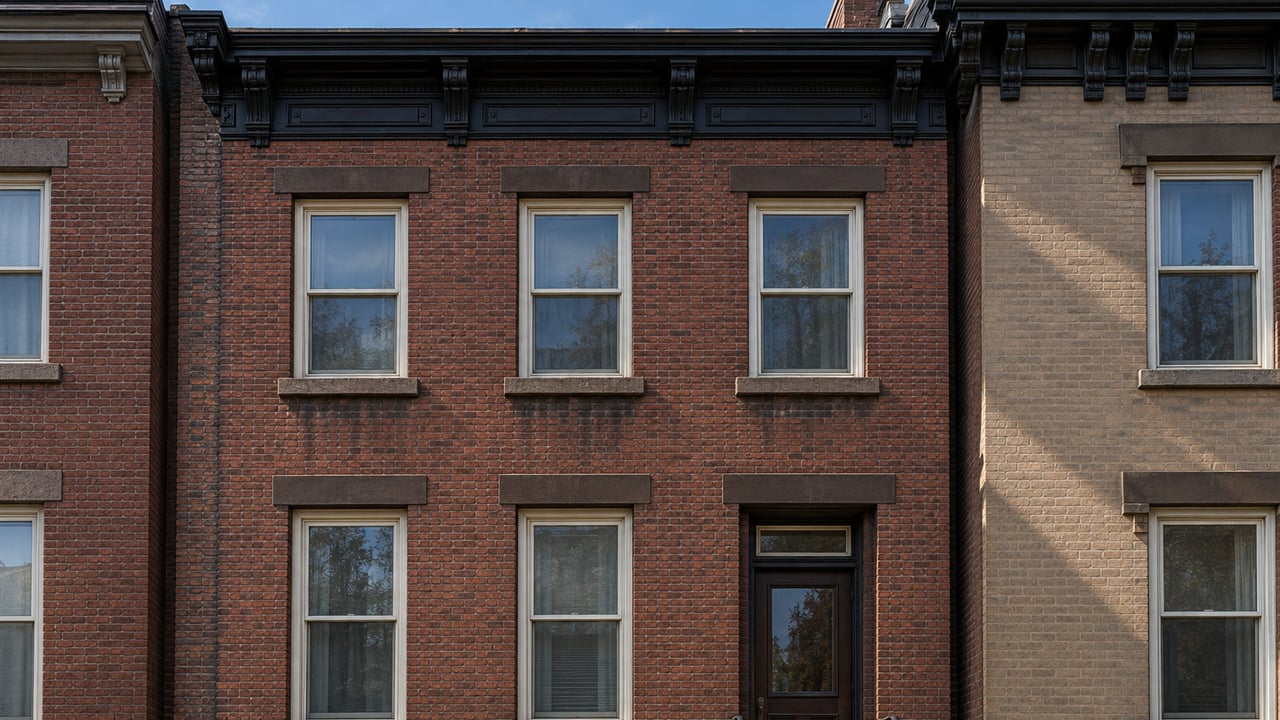
On July 1, 2026, a three-story, six-unit building at 1277 Lincoln Place in Crown Heights sold for $4.8 million. That works out to $800,000 per apartment and $657 per square foot. All six units were listed as free market. In April, about a mile west, 665 St. Marks Avenue sold for $3.8 million. It is a five-story elevator building from 1900 with 21 apartments, 13 of them rent-stabilized. That is roughly $181,000 per apartment and about $214 per square foot.
Both are prewar Crown Heights rental buildings near the same subway lines, and one sold for more than four times the other on a per-unit basis. One is entirely free market, and most of the other's apartments are stabilized. In 2026, how many units are stabilized has become the single biggest factor in what a Crown Heights income property is worth, and the rent freeze that took effect October 1 makes that split harder to close.
Renewals at frozen rents are already being signed, and the lawsuit is still open
The friction starts with the leases. The Rent Guidelines Board voted 7–1 on June 25, 2026 to set 0% increases for both one-year and two-year stabilized leases beginning between October 1, 2026 and September 30, 2027. Gothamist reported that this is the first two-year freeze in the board's history. The board's own order sets out the terms.
Owners groups have sued to annul it. On September 17, NY1 reported that Staten Island Judge Brendan T. Lantry ordered the city to turn over written communications between the mayor's office and board personnel from January 1 through June 25. He wrote that the allegations "have raised significant concern to this court regarding the lawfulness of the Board's procedure."
The freeze is still running while the case proceeds. CRE Daily reported on October 1 that renewal offers must go out at least 90 days before a lease expires, and owners have started sending them at frozen rents, which tenants are signing. The judge has so far declined to halt the freeze. One litigator quoted in that piece expects any increase that comes out of the case to be retroactive. The case is likely to run several more months, and a city appeal would automatically stay a ruling against the freeze.
Anyone pricing a stabilized Crown Heights building this fall is valuing an income stream that is fixed for now and legally open-ended later. A buyer's underwriter has to pick a number for 2027 rents without knowing which way the court will go.
Six units and 1974 decide which market a building trades in
Under the freeze, stabilization generally covers apartments in buildings built before 1974 with six or more units. Some apartments in buildings with certain tax breaks or subsidies are covered too. A typical Crown Heights two-, three- or four-family row house falls below that line. A walk-up of six to twenty units on a side street off Eastern Parkway usually falls above it.
Unit count alone doesn't settle the question. 1277 Lincoln Place has exactly six units, and all six were recorded as free market at sale. The status of each apartment is what the buyer paid for.
| 1277 Lincoln Place | 665 St. Marks Avenue | |
|---|---|---|
| Sale date | July 1, 2026 | Announced April 21, 2026 |
| Units | 6 | 21 |
| Rent status | All free market | 13 stabilized, 8 free market |
| Building | 3 stories, 7,308 SF | 5-story elevator, about 17,790 SF, built 1900 |
| Price | $4.8 million | $3.8 million |
| Per unit | $800,000 | About $181,000 |
| Per square foot | $657 | About $214 |
The St. Marks sale closed before the freeze vote. In its April 21 announcement of the sale, Marcus & Millichap described the pool of buyers for rent-regulated buildings as limited, and said the buyer was an international partnership. So the discount was already there in the spring, before the board voted.
Borough-wide numbers show the same split
The two Crown Heights sales follow a Brooklyn pattern. According to second-quarter 2026 data from GREA, the investment sales firm formerly known as Ariel Property Advisors, free-market Brooklyn buildings averaged $510 per square foot and about $510,653 per unit. The firm's heavily regulated category, which its release describes as buildings with "75+ rent stabilized units," averaged $167 per square foot and $146,000 per unit. On a per-unit basis, that is roughly a 3.5-to-1 gap across the borough. Per square foot, it is about 3-to-1.
Volume is moving apart as well. In the firm's first-half 2026 Brooklyn report, total multifamily dollar volume fell 19% from the first half of 2025, to $1.46 billion. Buildings with ten or more units, where regulated apartments are concentrated, dropped 30% to $850 million. Smaller multifamily buildings rose 16% to $410.1 million, and the report describes local owner-operators as active in buildings under six units. Average Brooklyn multifamily pricing fell to $333 per square foot, the lowest since 2015, and the blended cap rate rose to 7.06%.
No source found so far shows buyers moving into two- to five-unit buildings because of the freeze, and no one has measured a price premium for staying under six units. The data shows two segments heading in opposite directions in the same half-year. These are the most recent full Brooklyn breakdowns available. No third-quarter 2026 report had been published as of mid-October.
Why a freeze hits some rent rolls harder than others
On paper, citywide averages looked healthy going into the vote. The board's 2026 income and expense study, which covers 2023 to 2024, found that net operating income for rent-regulated buildings rose 6.2%, with expenses up 4.2%. THE CITY reported that buildings with a higher share of stabilized apartments saw smaller NOI gains, and that 9.2% of properties had negative NOI in 2024. The same article quoted Mark Willis of NYU's Furman Center, who said the NOI figures shown to the board were "probably much higher than they actually are."
A blended average mixes buildings like 1277 Lincoln Place with buildings like 665 St. Marks. In its mid-year outlook, GREA puts the gap for regulated buildings this way: operating expenses rose a cumulative 40% over five years, while allowed rent growth totaled 16%. The firm expects the two-year freeze to push stabilized values down further. A building where 13 of 21 apartments are frozen through at least late 2027 absorbs that pressure on most of its income. A building where all the rents reset at market absorbs none of it.
Financing reinforces the gap. In an August 7 analysis, the law firm Altman & An said banks were pulling back from rent-stabilized multifamily, and that required debt service coverage on older buildings was climbing above 1.30x. That points to smaller loans and tighter covenants at refinancing. The firm presents this as its own market observation. When borrowing is harder, fewer buyers can bid on the deal, and the limited buyer pool from the St. Marks sale shrinks further.
The low end of the stabilized market on Eastern Parkway
At the far end of that spectrum, prices stop reflecting rent rolls at all. On September 3, 2026, the mayor's office announced the transfer of three rent-stabilized Crown Heights buildings to a new owner: 1018 Eastern Parkway, 1074 Eastern Parkway and 1392 Sterling Place. Together they hold 88 homes and nearly 1,000 open code violations, and they are enrolled in HPD's Alternative Enforcement Program. The Real Deal reported that the deal used an auction and credit-bid structure, with $7.6 million in total consideration covering municipal fines, a defaulted mortgage, civil penalties and a judgment. That figure is not a clean sale price and shouldn't be used as a comp. It does show that debt, violations and repair obligations can set the price of heavily regulated buildings more than rent does.
Borough-wide, the benchmark for deeply regulated stock came from the Brooklyn portion of the Pinnacle Group portfolio, concentrated in Flatbush. Its 2,692 units sold out of bankruptcy for $212.9 million, about $79,000 per unit.
What sets the price of a specific Crown Heights building
The research points to a short list of facts that decide which pricing world a building belongs to. Most appear on the rent roll and in the building records before anyone looks at comparable sales:
- Year built and legal unit count. Pre-1974 construction with six or more units brings the building under the stabilization framework.
- Status of each apartment. As 1277 Lincoln Place shows, a six-unit building can trade as fully free market.
- Share of stabilized units. The borough data puts the most heavily regulated category far below free-market buildings, and mixed buildings like 665 St. Marks fall in between.
- Renewals signed since October 1. Frozen-rent leases are binding for their term while the lawsuit continues, which fixes part of the income for one or two years.
- Tax benefits or subsidies. These can bring apartments under the freeze even in buildings that otherwise fall outside it.
For an heir or executor with a small Crown Heights building, these questions decide whether the likely buyer is a local owner-operator in the sub-six-unit market that grew in early 2026, or a buyer from the limited pool pricing regulated income at a deep discount.
FAQ
Does the freeze apply to a three-family brownstone? Generally no. The freeze covers stabilized apartments in pre-1974 buildings with six or more units, plus certain apartments in buildings with tax breaks or subsidies.
Could frozen rents be raised retroactively? It's possible. Judge Lantry has not halted the freeze, but the case is ongoing. One litigator quoted by CRE Daily expects any resulting increase to be retroactive, though collecting it may not be practical.
What did increases look like before the freeze? The board approved 3% for one-year leases and 4.5% for two-year leases in 2025. In May 2026, it set a preliminary range of 0% to 2% for one-year leases and 0% to 4% for two-year leases before voting for the freeze.
If you're an executor, heir or owner deciding what a Crown Heights building is worth this fall, the rent roll and lease history will tell you more than any neighborhood median. Ronit Abraham can go through the unit-by-unit status with you, explain how buyers in each segment are pricing buildings right now, and set out the next steps in plain terms. Request a complimentary market or probate consultation.
This article is general information, not legal, tax or financial advice. Consult a qualified professional about your situation.