Did every brownstone between Smith Street and Hoyt Street really become worth twice as much in a single year? That's the headline sitting on top of Carroll Gardens right now. In the second quarter of 2026, the neighborhood's median sale price hit $2.68 million, up roughly 100 percent from the same quarter a year earlier, enough to make it the most expensive neighborhood in Brooklyn and the fourth most expensive in all of New York City. It's a real number from a real report. It's also the kind of number that tells you almost nothing about what's happening to any specific house, including the one you might be trying to buy or sell.
If you're comparing Carroll Gardens against Cobble Hill or Boerum Hill right now, the doubled median is probably the first thing you saw. It shouldn't be the last thing you think about.
What Actually Changed Between April and June
The market data firm PropertyShark tracks these numbers quarterly, and its own breakdown of the Q2 2026 figures points to something other than uniform appreciation. Two co-ops and two houses traded in the neighborhood that quarter. A year earlier, in Q2 2025, it was four co-ops and zero houses. That's not the same market measured twice. That's two different products being averaged into one number.
Add in a small number of unusually large sales and the picture gets clearer. Three units at 238 Degraw Street sold for between $2.35 million and $4.49 million. A 3,960-square-foot brownstone closed at $7 million. A 4,478-square-foot brick townhouse fetched $7.5 million. Those are real closings, and they're worth noting for what they say about the ceiling on Carroll Gardens inventory. But a market with only 17 total deals in a quarter doesn't need many trophy sales to swing its median hard in either direction. It marked the third straight quarter the neighborhood closed north of $2 million, which is a genuine trend. It does not mean the typical house got twice as expensive in twelve months.
Redfin's numbers from earlier the same year make the point even sharper. In February 2026, the site put Carroll Gardens' median sale price at $2.5 million, down 10.7 percent from a year before, with homes sitting on market a median of 50 days compared to 35 days the prior year. Two data sources, two different windows, two different stories, same eight-block neighborhood.
| Source | Time window | Median sale price | Change vs. a year earlier |
|---|---|---|---|
| PropertyShark | Q2 2026 (April to June) | $2.68 million | Roughly +100% |
| Redfin | February 2026 | $2.5 million | -10.7% |
Neither number is wrong. Both are measuring a market thin enough that a handful of closings can move the headline in a way that would be impossible in a neighborhood with hundreds of sales a quarter. That thinness is the first thing worth understanding before you use any single median to plan a purchase or a listing price.
The Real Reason Carroll Gardens Behaves Differently
The composition story explains why the number moved. It doesn't explain why Carroll Gardens commands a premium over Cobble Hill and Boerum Hill in the first place, even in quieter quarters. That answer predates every market report by about 180 years.
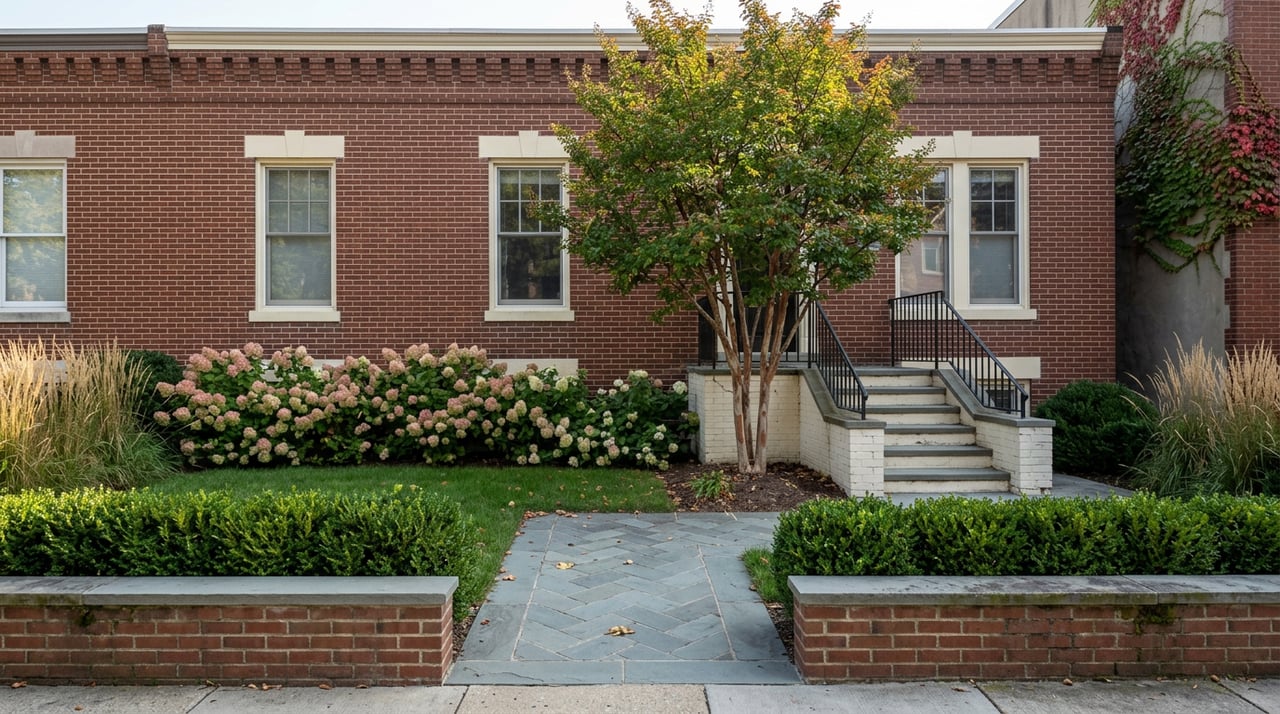
In 1846, a surveyor named Richard Butt laid out the blocks that would become Carroll Gardens with something almost no other Brooklyn rowhouse neighborhood has: a mandated setback pulling homes well back from the street, deep enough on some blocks to run close to 30 feet. Cobble Hill doesn't have it. Boerum Hill doesn't have it. Walk south on Court Street past Degraw and you'll notice the change in real time, houses set behind actual yards instead of rising flush with the sidewalk.
That layout is now protected inside the Carroll Gardens Historic District, designated in 1973 and covering roughly the blocks between Carroll Street and President Street, from Hoyt Street to Smith Street. Owning inside that boundary doesn't freeze a house in amber. It does mean visible exterior changes, facade work, window replacement, anything the street can see, goes through Landmarks Preservation Commission review before it happens. That's a real timeline consideration if you're buying a fixer-upper here expecting to move fast on renovations.
The setback and the landmark designation together do something a market report can't: they cap supply permanently. No amount of demand builds a new front garden on a Boerum Hill block. That scarcity, not the quarter-to-quarter median, is the actual mechanism behind Carroll Gardens trading above its neighbors over the long run.
What This Means If You're Weighing Carroll Gardens Against Cobble Hill or Boerum Hill
Here's where the two threads meet. The headline median tells you Carroll Gardens jumped past Columbia Street Waterfront, DUMBO, Park Slope, Fort Greene, and Cobble Hill in Q2 2026 rankings of Brooklyn's priciest neighborhoods, all of which closed that quarter in the $1.7 million to $1.9 million range. The setback story tells you why that gap is likely to persist even after this particular quarter's composition effects fade.
Practically, that plays out across a few price bands. Renovated single-family brownstones in Carroll Gardens and the surrounding prime row-house belt have been trading roughly between $2.5 million and $4 million depending on condition and garden depth. Two-family properties with rental income potential run higher. Trophy sales, the kind that pushed this spring's median up, sit at $7 million and above, and they're rare enough that one or two of them can distort a quarterly average without representing what a typical buyer will actually pay. On the accessible end, condo units in converted buildings still start closer to $800,000 for a one-bedroom, which is where most buyers priced out of the single-family market end up looking.
If you're cross-shopping Cobble Hill or Boerum Hill because the sticker price looks gentler, that's a reasonable instinct. Just know you're also shopping out of the garden setback and, in most cases, out of the same depth of landmark protection. For some buyers that's an acceptable trade. For buyers whose whole reason for wanting Carroll Gardens is that front-yard streetscape, no amount of price comparison in a neighboring zip code substitutes for it.
A Practical Filter Before You Trust the Next Headline Number
A few habits make the median less misleading, whichever side of a transaction you're on.
Ask what actually sold, not just what the average said. A quarter with two houses and two co-ops tells a different story than a quarter with four co-ops and no houses, even if the median lands on the exact same number.
Look at price per square foot alongside the sale price. It's still affected by which properties happened to close, but it normalizes for the fact that a 4,478-square-foot townhouse and a one-bedroom co-op are not comparable units even when they trade in the same three months.
Treat three consecutive quarters above a threshold, like the $2 million mark Carroll Gardens has now cleared three times running, as more meaningful than any single quarter's percentage change. Trends built from repetition tell you more than a single data point ever will.
And if you're touring a property inside the historic district, ask about landmark status and required approvals before you fall for the facade. Cosmetic work that would be routine outside the district can mean a Landmarks Preservation Commission review process elsewhere.
A Few Questions Worth Asking Before You Compare Neighborhoods
Does every house in Carroll Gardens actually have a front garden? Most blocks within the historic district carry the deep setback, but garden size and condition vary block to block and house to house. It's worth walking the specific block rather than assuming uniformity across the neighborhood.
Why don't Cobble Hill or Boerum Hill have the same setback? They were platted under different surveying decisions in the same era. Carroll Gardens' 1846 layout was distinct from the start, which is part of why the neighborhood eventually developed its own identity separate from what became Cobble Hill and Boerum Hill.
Does landmark status make every renovation harder? It affects exterior and street-visible work most directly. Interior renovations generally have more flexibility, but any change to a facade, window, stoop, or roofline visible from the street should be planned with LPC review timelines in mind from the start.
The number on the headline is real. What it's built from is the part worth understanding before you act on it. If you're weighing Carroll Gardens against its neighbors, or trying to figure out what a listing price actually reflects about the current market, Ronit Abraham can walk through the comparable sales behind any number you've seen and what they mean for your specific situation. Request a complimentary market consultation to start with the data instead of the headline.