On Saturday, October 17, 2026, the Brownstoners of Bedford-Stuyvesant will open roughly a dozen private homes to the public for this year's tour. Tickets run $40 plus a service fee, or $35 with the group promo code, and check-in happens at Boys and Girls High School, 1700 Fulton Street, where ticket holders receive the brochure required to get into each house on the route. The self-guided walk runs from 11 a.m. to 4 p.m. Before any of that starts, there's a free Homeowner and Buyer Panel from 9 to 10:30 a.m., moderated by Wayne Devonish of the Bedford Central Community Development Corporation, covering group purchase options, home inspections, hiring contractors, refinancing, grants, and insurance. This year's theme is "love, soul, and the place we call home."
That's the tour in outline. What's less obvious, unless you've been paying attention to Saratoga Avenue, Tompkins Avenue, and Howard Avenue this year, is how much has changed at street level since the last time this event ran. The tour's mission has stayed the same since 2020, when it went virtual for a single pandemic year before returning to its in-person format. The storefronts around it have moved considerably.
The Tour's Purpose Hasn't Changed. That's the Point.
The Brownstoners of Bedford-Stuyvesant was founded to make the case that a historic Black neighborhood full of row houses was worth investing in, worth restoring, worth living in for the long term. Forty-eight years later, the tour still runs on that same logic. A portion of ticket proceeds goes to two scholarship funds, the Bernard McDonald and George Glee Jr. Memorial Scholarship and the Joan E. Maynard Scholarship, both awarded to college-bound graduates of Boys and Girls High School and Brooklyn Academy High School. This year's fundraising goal is $30,000.
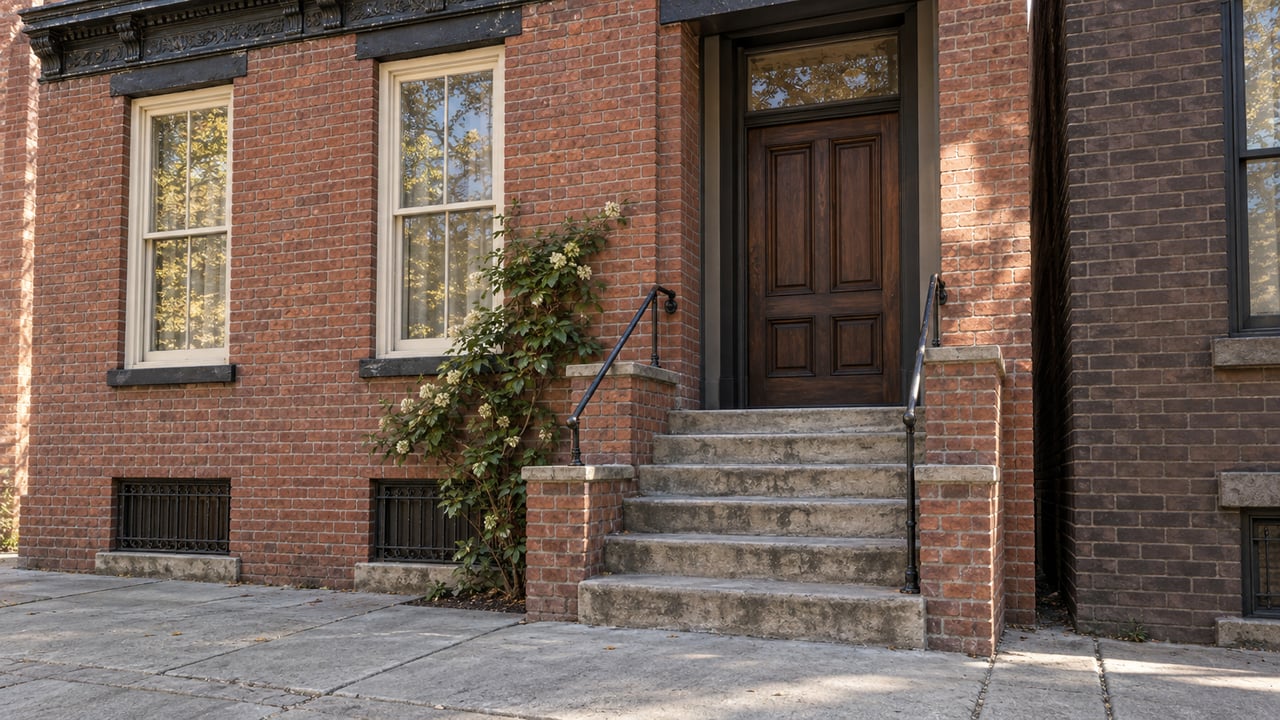
The homes on the route change year to year, but the neighborhood's signature blocks don't. Some of the most photographed brownstone rows sit on MacDonough Street between Lewis and Stuyvesant avenues, where several houses have front lawns instead of stoops straight to the sidewalk, an unusual setback for Brooklyn row houses. Greene Avenue between Bedford and Nostrand has some of the largest single-family brownstones in the district. Macon Street between Tompkins and Marcy, Jefferson Street near Marcy, and Madison Street off Marcy round out the blocks most tour guides point people toward. None of that is new information to anyone who has lived in Bed-Stuy for more than a season, but it explains why the tour keeps drawing people back: the architecture doing the work is the same architecture that was here in 1978.
What's Different Is the Ground Floor
Walk a few blocks from any of those tour houses and you'll find a stretch of storefronts that looked completely different a year ago. Peral, a coffee shop and taqueria from the team behind Mexico City's Cicatriz and Brooklyn's own Olmo, began full dinner and lunch service at 105 Saratoga Avenue on September 2, serving house-made corn tortillas, guisados, and salsas, with a morning coffee-and-tamales counter running alongside it. Olmo itself, the Mexican tapas bar a few doors down that commissioned artist Alannah Farrell to paint its facade mural, opened at 103 Saratoga last year and is now old enough that Peral is described as its sister project.
A few blocks over on DeKalb Avenue, Fresh Pops is finishing its build-out at 564 DeKalb, a self-described music-first neighborhood bar built around drinks, food, and live sets. Its own progress page currently points to a September or October opening, which would put its debut inside the same few weeks as the house tour itself.
Further down Howard Avenue, Cicchetti BK, which opened this past March at 185 Howard, has settled into a schedule that's more consistent than most new openings manage: free jazz Tuesday and Sunday nights from 7 to 9, plus a daytime community space called Cicchetti Commons open Tuesday through Sunday from 2 to 5, alongside its Venetian-style small plates and a wine list of 15 by the glass. During the day, Barker, the scratch-made lunch counter that opened in the neighborhood in late 2025, has kept extending what Nostrand Avenue is used for outside of dinner hours, with a changing menu of sandwiches, soups, and pastries from chefs Gracie Gardner and Henry Wright. And at the former Macon Hardware space, journalist Nikole Hannah-Jones is developing a project called North Star with Rotimi and Ayo Akinnuoye, the longtime owners of Bed-Vyne, though no opening date has been confirmed yet.
None of this is a coincidence of timing with the house tour. It's a separate signal pointing at the same thing: people are willing to put real money into fixed-up storefronts on these blocks, the same way tour participants are willing to put real work into fixed-up interiors a few doors away.
The Park in the Middle of All of It
If you're tracing a route between tour houses and new restaurants this fall, you'll likely pass through Herbert Von King Park, which sits between Marcy and Tompkins avenues and predates almost everything else on this list. Built in 1871 as Tompkins Park, it was designed by Frederick Law Olmsted and Calvert Vaux, the same team behind Prospect Park and Central Park, which makes it one of the oldest parks in Brooklyn. Today it holds a Cultural Arts Center with an indoor dance studio, an outdoor amphitheater used for free concerts, a baseball field, and barbecue areas, all inside 7.8 acres that also happen to be home to the only tree in New York City with individual landmark status.
The park's role as a cultural anchor goes back further than the current programming. Its stewardship history includes the Magnolia Earth Tree Center, started by urban gardener Hattie Carthan, whose work protecting the neighborhood's tree canopy predates most of the current restaurant boom by decades. That kind of continuity, an institution that keeps doing the same civic work regardless of what's opening or closing around it, is the same quality that keeps the house tour relevant. Neither one needs the other to succeed, but they're both proof that long-running institutions and new storefronts can occupy the same four or five blocks without one crowding out the other.
For anyone looking for something to do on either side of a jazz set or a plate of gyoza, the neighborhood's visual art scene runs along similar lines. The Bishop Gallery and Richard Beavers Gallery both focus on Black artists and sit within easy walking distance of the tour's usual routes, while Bar Lunático and BrownstoneJAZZ handle the live music side of things most nights of the week.
Reading the Weekend
None of this changes what the house tour is for. It's still a fundraiser for two scholarship funds, still run by the same volunteer organization, still built around the same idea that showing off a restored parlor floor is worth $40 and a Saturday. What's changed is what's waiting outside when the five hours are up. A year ago, the walk from Boys and Girls High School toward the MacDonough Street rows didn't pass a taqueria doing full dinner service or a wine bar with a standing jazz night twice a week. This year it does.
If you're planning to spend October 17 on the tour, tickets and the full event schedule are on Eventbrite, and the NYC Parks page for Herbert Von King Park has current hours if you want to build the park into your route.
Ronit Abraham lives and works in Brooklyn's brownstone neighborhoods and pays attention to what's opening, closing, and changing on the blocks she covers. If you're curious about a specific house on this year's tour route, or just want to talk through what a fall like this one tends to mean for a block, Ronit Abraham is a good person to ask.